Buying guides
How to Choose a Diamond Painting Supplier: Nine Questions That Change the Outcome
Most supplier problems are decided before the first order - in the questions nobody asked. These nine cover the gaps that cost the most money and the most reorders.
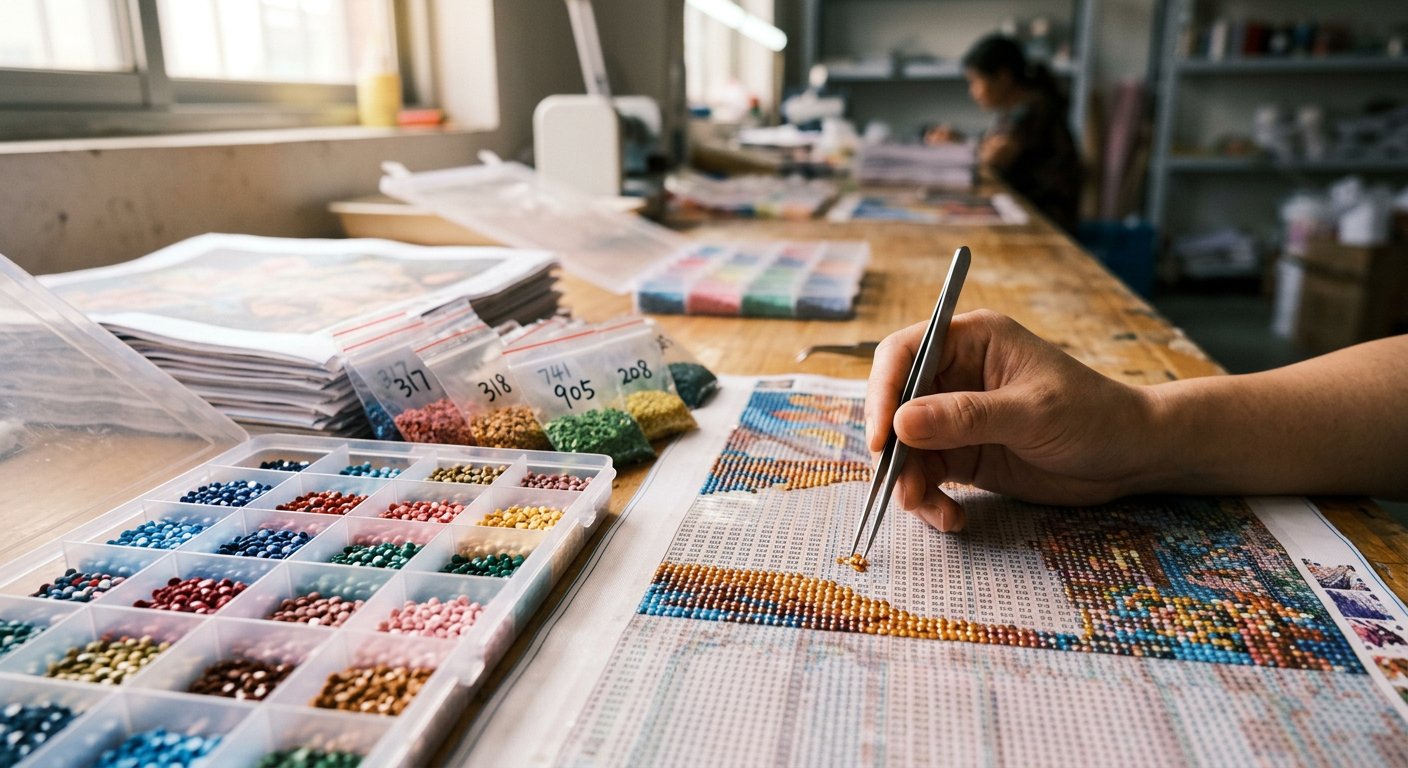
Almost every bad supplier story in this category starts the same way: a price was agreed before the specification existed. The kit arrives, the drill counts are short, the packaging is plain, the cartons do not fit the shelf - and none of that is a scam, it is just a conversation that never happened.
These nine questions are the ones that change the outcome. Ask them in one email, in writing, before money moves. A supplier who answers them precisely is telling you something. So is one who answers them vaguely.
1. What exactly is in the box?
Not "a diamond painting kit" - the list. Canvas with the chart printed on it, drills in numbered bags, a pen, a ridged tray, a wax pad, spare bags. Then the sizes: canvas in centimetres, drill diameter in millimetres, number of colours. Two suppliers quoting the same unit price for "a 40x50" can be selling you 20% less plastic if one omits the tray and the spare bags, and the customer notices the omission on the kitchen table, not in your spreadsheet.
2. Are the drill counts stated per colour, and is there a margin?
This is the single most common complaint in the category and it is entirely preventable. A good kit ships about 20-30% above the chart count on each colour, plus a little extra on the largest colours. Ask for the packing sheet or the count table. If they will not supply one, assume the margin is thin and price your replacement-drill policy accordingly.
3. Which drill, on which canvas?
Round or square, resin or acrylic, and how closely the colour numbers map to DMC. Round drills are forgiving and faster to place; square drills give a gap-free finish and demand more accuracy. DMC mapping matters because it is how your customer buys refills - if colour 17 in your kit is "some orange", they cannot top it up. Ask what a customer should buy when a colour runs out. The supplier who has an answer has been asked before.
4. What is the minimum, and per design or per order?
"50 kits" means very different things if it is 50 of one design or 50 across ten designs. For a shop testing the water, a per-order minimum across a mixed palette is far more useful than a deep commitment to one picture. Confirm whether a mixed carton carries a surcharge.
5. What is the lead time from proof approval, not from enquiry?
Quotes usually quote production, not the calendar. The clock that matters starts when you approve the proof and pay the deposit. Ask separately: how long to quote, how long to produce a proof, how long to produce after approval, and how long to get it to the port or your door. November is not the month to discover the fourth number.
6. Who owns the artwork, and what proof do I approve?
If you supply the artwork you should keep the rights, in writing, and the supplier should confirm they will not resell your design to anyone else. The proof you approve should show the actual drill count, the finished size and the chart legibility at final scale - not a pretty mock-up of the photo. A design that reads beautifully at 3000 pixels can be an unreadable mosaic at 40x50.
7. What happens when a bag is short?
Get the replacement policy in writing, and make the answer specific: how do you report it, what evidence do you need, how is it shipped, who pays. Kits are packed by people, so a short bag will happen; what separates suppliers is whether the fix takes three days or three weeks.
8. Where does the price stop?
FOB, CIF, DDP - these are not trivia, they are the difference between a 4.20 unit cost and a 6.10 landed cost. FOB means the quote ends at the port and you arrange freight, insurance, duty and last-mile. Add all of it before you compare two suppliers, and remember that on a small order the freight is a larger share of the total than the product is.
9. Is it a factory or a trading company?
Neither is automatically better, but you should know which you are buying from, because it decides who can actually change the packaging, the drill colour or the carton size when you ask. Ask for a short video call with the production line running, or footage with your name and the date said out loud. A trading company will struggle to produce that in an afternoon; a factory will not think the request is unusual.
A sampling protocol that actually tells you something
Order three designs, paid, through the same path a bulk order would take - same proof, same packaging, same courier. Then check, in this order:
- Registration: are the symbols sitting inside the grid squares, or drifting?
- Drill fit: place fifty drills by hand. Any that sit proud, rock, or need force are a cut problem, and it will show up across the whole run.
- Chart legibility: can you read the legend under normal room light, without a magnifier?
- Bag numbering: does bag 12 correspond to symbol 12, on every kit in the box?
- Edge margin: is there enough spare canvas to frame without covering a row?
- Colour spread: do the mid-tones separate, or band into stripes?
One kit passing tells you the line can do it. Three kits from three different designs tells you it does it consistently.
Red flags worth taking seriously
- A price that is a third below everyone else, with no explanation of what was removed to get there.
- No willingness to name the drill manufacturer or the canvas weight.
- Quotes that arrive as a screenshot of a chat rather than a document.
- Reluctance to send a paid sample - the one request a genuine factory never minds.
- Pressure to order before a price rise that is "next week".
The six lines to put in writing
Before the deposit, send an order specification that covers: kit contents, canvas size and weight, drill type and colour count with margin, packaging (plain, white label or branded), Incoterm and destination, and lead time from proof approval. If a supplier will not confirm those six in an email, the rest of the relationship will be improvisation too.
For the other side of this - what a supplier's published terms actually tell you - see how we score the profiles on this site, and browse the wholesale supplier rankings where minimums and lead times are recorded next to the ratings.
Where to start
Three profiles worth reading next, because they illustrate the three shapes this question takes: 5D DP (fixed 50-kit minimum, numbered bags, no private label), Diamond Painting TG (mixed cartons and trade-only pricing) and Bling Diamond Painting (own factory, OEM and private label, quote-based minimums).
Keep reading
- All 21 wholesale suppliers, ranked
- Round vs square drills: what the difference costs
- How the reviews and rankings work
Written and edited by the Diamond Painting Reviews team. We do not take payment for coverage, placement or links, and the suppliers named in this article had no say in what it says. Something out of date? Tell us and we will correct it.