Craft basics
Reading a Diamond Painting Chart: Symbols, DMC Codes and What “Full Drill” Really Means
A chart is a compressed file format pretending to be a picture. Once you can read one, you can judge a kit before you open the box.
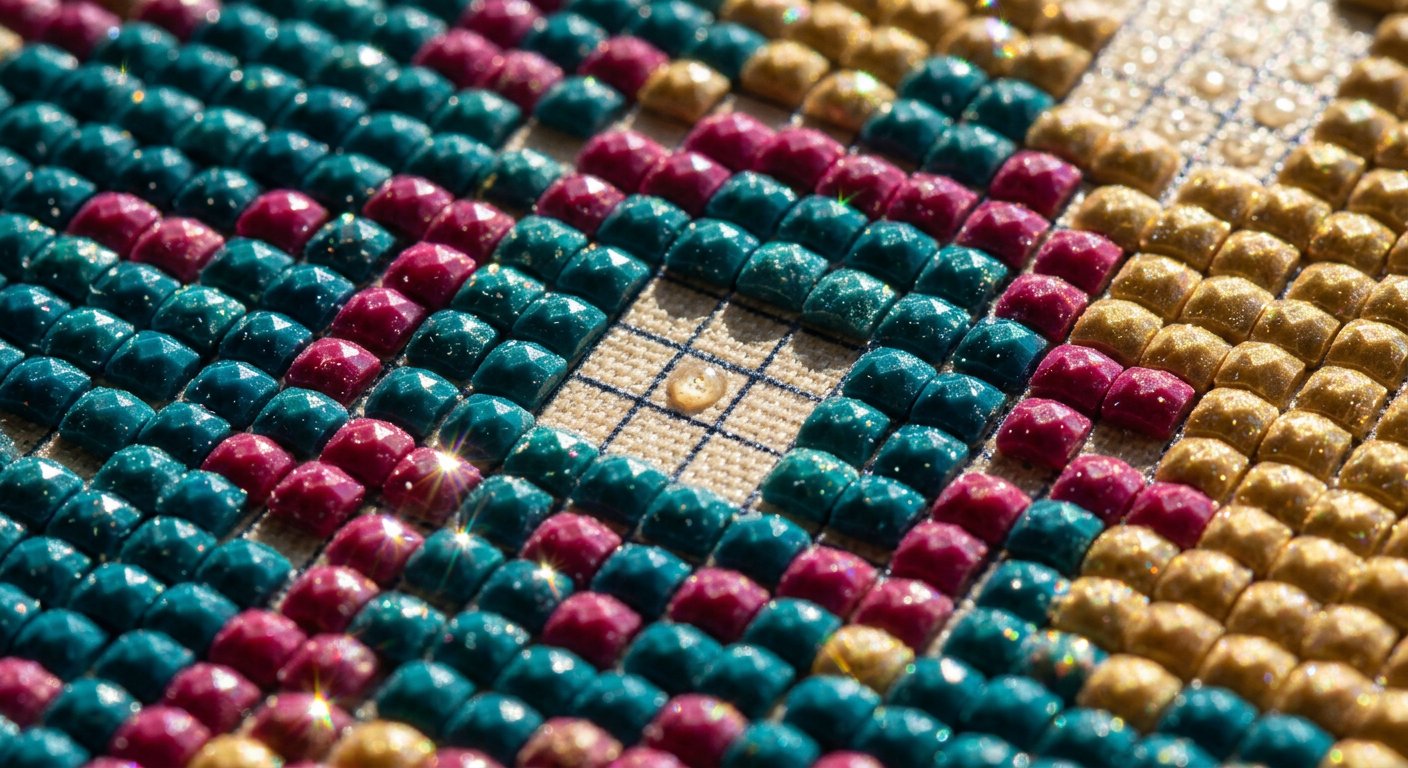
Every diamond painting is two images at once: the picture you are making, and the chart you are following to make it. The second one is printed over the first, and it is where most of the frustration in this hobby lives.
The anatomy of a chart
Open a canvas and you will see a grid of adhesive squares. Inside most squares is a symbol - a letter, a digit, a punctuation mark, occasionally a small graphic. Around the edge, or on a separate panel, is the legend: a table where each symbol is matched to a colour number, a DMC code and a swatch.
The workflow is simple: find the symbol in the grid, look it up in the legend, pick up that bag of drills, place one. Everything that goes wrong in that loop is either a chart problem, a legend problem or a bag-numbering problem - and all three are things you can check before you start.
Why symbols, and not just colour
Because printing a colour-accurate swatch under every one of forty thousand squares would make the chart unreadable and the canvas expensive. Symbols are a compression format: a letter can be distinguished at two millimetres where a shade of teal cannot - especially under a lamp, on an angle, at ten in the evening.
Which is why symbol collision is the defect worth looking for: O and 0, I and 1, S and 5, c and C. On a cheap print they are indistinguishable, and you will place the wrong colour across a section before you notice. Scan the legend for near-identical pairs before you start. Suppliers who care about this print the symbols at a heavier weight and avoid the ambiguous ones altogether.
The legend, and what DMC means here
DMC is a thread brand, and its colour numbering became the de facto reference for this whole category - the same way paint has Pantone. A kit that lists "DMC 310" for black is telling you what to buy when you run out, and roughly what the shade should look like. A kit that lists only "17" is telling you nothing, and your only refill option is to hope the supplier sells spares.
Two things to know:
- DMC matches are approximate. The drills are plastic, the thread is cotton; the same number can look noticeably different in the two materials, particularly in the yellows and violets.
- Not every kit uses DMC at all. Cheap ranges often use their own numbering, which is fine right up until a colour runs short.
Full drill, partial drill, and what the words promise
Full drill means every square in the grid gets a gem - no bare canvas in the picture area. Partial drill means only some squares are drilled, usually to make a cheaper kit, to add sparkle to a printed background, or in some gift formats (bookmarks, cards) where the image is printed and only the highlights are gemmed.
Partial drill is not a scam, but it is a different product, and "5D" tells you nothing about which one you are buying. If the listing does not say full drill, assume partial until the supplier confirms it in writing.
AB drills and why they cost more
AB (aurora borealis) drills carry an iridescent coating that shifts colour with the angle of light. They are used sparingly as highlights - water, glass, stars - and they cost more per drill than a standard colour, which is why a kit with twenty AB colours is priced differently from one with two. If a supplier substitutes standard drills for AB without saying so, the finished piece loses exactly the effect the design was built around.
Checking a chart in sixty seconds
- Symbol size: can you read the legend from arm's length in ordinary light?
- Collisions: any O/0, I/1 or S/5 pairs in the same legend?
- Legend completeness: does every symbol in the grid appear in the legend, and vice versa?
- Bag numbers: do the physical bags match the legend numbers, all the way up?
- Edge margin: at least 10-15 mm of blank canvas outside the picture, or you will lose a column of drills when framing.
- Grid registration: are the symbols centred in their squares, or drifting half a cell to the right across the canvas?
Any failure on 1, 2, 4 or 6 is a reason to reject a batch, not a reason to work around it. Those are printing and packing errors, and they repeat across an entire run.
When a colour runs out
Use the DMC code to buy the nearest match, and do not worry about a perfect one - a slightly different shade in a run of twenty drills is invisible; a bare square is not. If the kit has no DMC codes, email the supplier with the legend number before you start, not after. The ones who reply with a code are the ones worth buying from again.
Related reading: how round and square drills differ in practice, and the nine questions to ask a supplier. If you are buying for a shop, the shop rankings record drill counts and delivery alongside the ratings.
Keep reading
Written and edited by the Diamond Painting Reviews team. We do not take payment for coverage, placement or links, and the suppliers named in this article had no say in what it says. Something out of date? Tell us and we will correct it.